Naxios
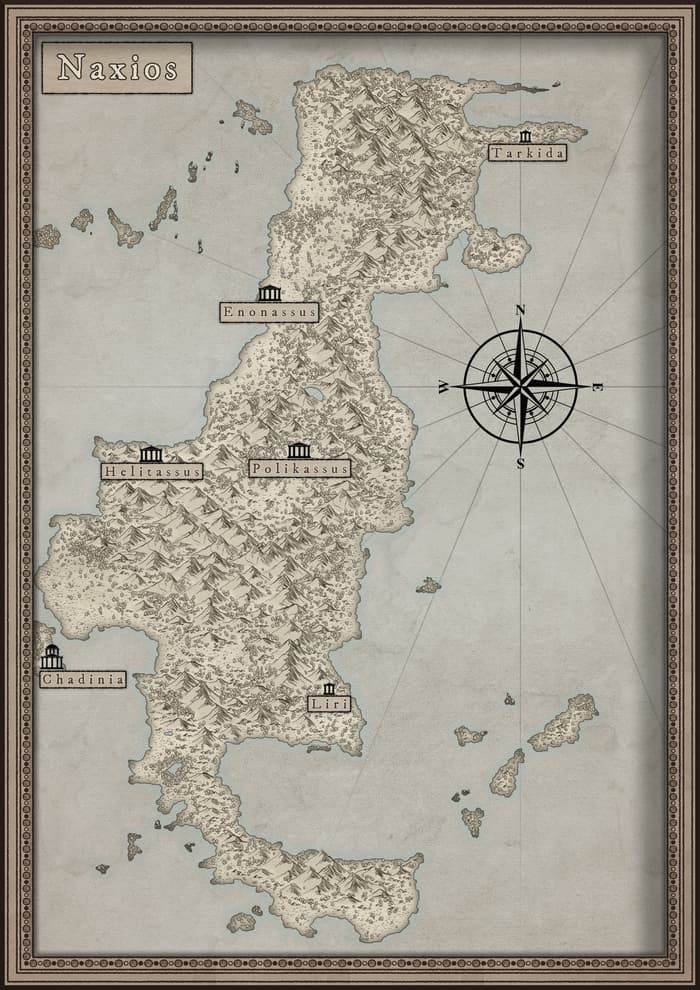
Naxios is the largest island belonging to the Realm of Eros. Naxios is also seen as the cradle of the Erosian civilization.
During the the Nemisian Civil War (193–195 AAC) against the Nemisian League almost all cities on the island of Naxios supported the side of the Erosians.
History
It is said that the dawn of men began on the island of Naxios, east of Helissia and the mighty City of Eros, which had not yet been founded. Men themselves were newly shaped by the god Hamon when the war between Gods and Titans broke out, and these first humans fled the region of Helissia for the safety of Naxios, far from the fighting gods who scourged the earth. There they raised the cities of Liri and Tarkida, sheltered from the ravaging armies of the Titans. It was an age of hiding for men: the gods were too consumed by their war with the Titans to take notice, and humanity waited in its small cities for its time to come. Though called cities, by later standards these would have been little more than villages, each ringed by a modest wooden wall.
After the war ended, and the dust had settled over Aurea following the first departure of the gods and titans, it was on Naxios that the earliest human civilization took root. Culture, society, and the first forms of government were born in Liri and Tarkida. They were soon joined by the city-states of Enonassus, Helitassus, and Polikassus, and the first shrines and temples to the Aurean gods were raised.
Where Liri and Tarkida kept a wary distance and stayed out of each other’s affairs, the same could not be said of the other cities that rose on Naxios. It was not for nothing that one of the island’s most revered gods, Straton, became known as the god of war. Though Straton, too, eventually left Aurea, his influence lingered on the island, and it was said he still stirred, unseen by the other gods, in the affairs of men.
In the years before the founding of the Realm of Eros by Aison I in the year 1AAC, the city-states on the island of Naxios were locked in constant war with one another. This was rooted in the island’s tradition that Naxios could have only one king, one representative of the gods, who alone bore the title Anax Andron, King of the People.
It was not until the rise of king Krinatox of Helitassus in the year 4BAC that all the cities finally bowed to a single ruler. One by one, he brought the cities of Naxios to heel.
Eventually the warlike king’s fortunes turned when he invaded Helissia in the year 2 BAC. After a string of resounding victories, including the capture of the City of Eros, Krinatox’s army lost its momentum. A crushing defeat came at the gates of Arretta, home of the famed Oracle of Arretta, at the hands of the armies of Aison I. Krinatox died soon after, and with him died the power of Naxios, never to be restored.
From that point on, Naxios was no more than a province of the mighty Realm of Eros, and every emperor of Eros thereafter bore the honorary title Anax Andron.
Yet Naxian culture left its mark on Erosian civilization all the same. The island’s endless wars had given each city its own standing army, rather than relying on civilians to take up arms only when needed. The Erosians adopted this practice in turn: the first act of Emperor Aison I after his coronation was to raise the first standing army of Eros, the army that would eventually become the strongest army in the known world.
Gallery
Follow our newsletter
Related items
Hadnia “The Brave”

Tergamos I of Eros
Mamron Umer